

AI & Technology
Ephemeral AI Agents
Agents that do their job and don't linger — what ephemeral AI agents are, why they leave less standing risk, and how Connected Spaces implements the concept through ClawdBots and the Nest Protocol.
Most AI tools stay on. They maintain a persistent connection to your systems, hold credentials, and wait for the next command — at 2 PM and at 2 AM. That's fine when software just stores and displays data. It creates a different kind of problem when software can act on your behalf.
An agent that can send emails, commit budget, and modify records is also an agent that can be reached. If it runs continuously, it can be reached continuously.
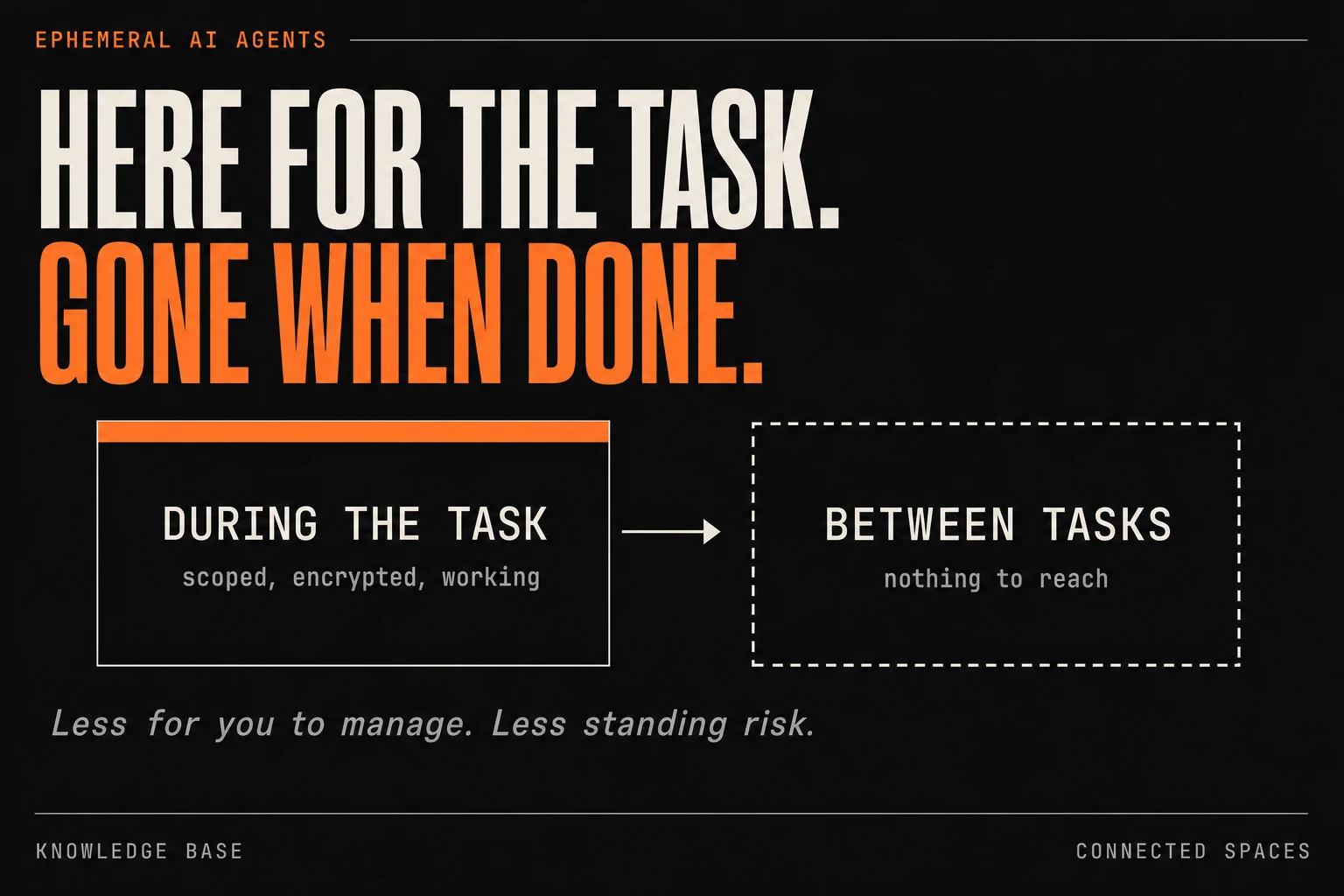
Ephemeral AI agents are a different design choice: they exist for the task. When the task is done, they're gone. Less for you to manage — and less standing risk between sessions.
What "Ephemeral" Actually Means
An ephemeral AI agent is created for a specific task and destroyed when that task is complete. It does not persist between sessions. It does not hold credentials at rest. Between the time you send a request and the next time you send one, there is no running process, no stored session token, and no accumulated state.
The contrast is a persistent agent — one that runs continuously, maintains an open connection to your systems, and is always ready to act. Many AI tools work this way: they stay connected to your calendar, email, or CRM and wait for a command.
The practical difference:
- A persistent agent is reachable between tasks. It holds its credentials. It can be targeted when nothing is watching.
- An ephemeral agent does not exist between tasks. There is nothing there to reach.
This is not a claim that ephemeral agents are immune to attack. It is a description of what the design removes as a target: the always-on process with standing access.
The Business Benefit First
Before the technical explanation: what does this mean for a business owner?
Fewer things to worry about between sessions. Your agents do their jobs — draft the supplier response, flag the anomaly, prepare the reorder recommendation — and when they are done, they are gone. You are not managing a fleet of persistent processes sitting in your systems with the lights on. The structure is cleaner, the footprint is smaller, and what requires your attention is what you explicitly approved.
It also means you are working with a governance posture most small and mid-market businesses have never had for software. Connected Spaces brings the structure: scoped roles, guardrails, approval gates, an audit trail. Not because the threat picture is catastrophic — because operational structure is worth having regardless.
How Connected Spaces Implements It
Connected Spaces AI Agents are called ClawdBots. They run under the Nest Protocol — the architectural framework that defines how they are created, governed, and destroyed.
Every ClawdBot is ephemeral by design. Six properties define this:
- Born for the task, destroyed after. Created per-request, torn down when done.
- Server-side only. Agent code never runs in the browser. Enforced at the architecture level.
- Identity rebuilt per request. Context comes from the authenticated session on every action — no cached identity that can be replayed.
- Scoped permissions. Each agent can only call the tools it was explicitly granted. The keycard only opens the doors it needs.
- Encrypted communications. Every credential encrypted with its own key.
- Working-memory isolation. Each agent's short-term task context is isolated — one agent's working state cannot bleed into another's. Long-term business knowledge is shared across all CNX agents via the accumulated memory layer; that is intentional, not a leak.
Born. Execute. Gone.
Ephemeral Agents vs. Chatbots vs. Persistent Agents
| Chatbot | Persistent AI Agent | Ephemeral AI Agent (CNX) | |
|---|---|---|---|
| Can take actions on your systems | Rarely | Yes | Yes |
| Exists between your requests | Yes | Yes | No — process does not persist |
| Holds credentials between sessions | Sometimes | Yes | No |
| Short-term working context per task | Cleared between chats | Retained across sessions | Discarded when the task ends (unless promoted to long-term) |
| Long-term / accumulated business memory | None | Often retained per-agent | Shared and accumulating across all CNX agents |
What this means in practice:
A chatbot has no durable memory — it does not build institutional knowledge over time. A persistent agent stays running between sessions and may retain memory at the agent level. CNX ephemeral agents take a third path: the short-term working context for each task is discarded when the task ends, but every insight that matters is promoted into the shared long-term memory layer. That long-term memory accumulates and is shared across all your CNX agents — so each new task starts informed, not blank.
Ephemeral ≠ no memory. It means your agents don't carry unnecessary working state between sessions — and what is worth keeping gets kept, permanently, in shared institutional memory.
A chatbot answers questions. A persistent agent acts continuously. An ephemeral CNX agent acts when called — short-term context discarded, long-term knowledge preserved — then vanishes.
For a business with real vendor data, real cost records, and real customer relationships, the question of what happens between tasks is a practical one. Ephemeral design with shared long-term memory is the architectural answer.
Under the Hood
We build on the guardrail and role controls in the modern multi-agent frameworks we use, plus our own guardrail layer. We don't reinvent the wheel; we configure it to your business and the level of risk you're comfortable with.
We are not a partner or certified affiliate of any AI or infrastructure provider.
For the full technical architecture — AES-256-GCM credential encryption, prompt injection defense, six governance pillars, human approval gates — see Governance and Security.
Note
Ephemeral architecture reduces the attack surface. It does not make anything unhackable or secure by design. We claim what the design does — not a state. Nothing is 100% secure.
What Ephemeral Design Actually Changes
Ephemeral AI agents are created for a specific task and destroyed when that task is complete. They do not persist between sessions or hold credentials at rest. The contrast is a persistent agent — always running, always reachable. Ephemeral design means there is no standing process between your requests.
Ephemeral does not mean no memory. The short-term working context for a task — the specific data the agent held while executing — is discarded when the task ends. But the long-term knowledge layer is preserved and accumulates. Every CNX agent builds on the same shared institutional memory, so each task starts informed, not blank. An insight captured today is available to every agent tomorrow. That is the Company Brain at work.
The practical benefit for a business owner is fewer things running in your systems between sessions. Agents do their jobs — draft, collect, analyze, flag — and when they are done, they are gone. No persistent process with standing credentials sitting in your stack, and less for you to manage as a result.
Does that mean lower risk? Specifically: it reduces the attack surface by eliminating a common target — a persistent process with standing credentials. When an agent does not exist between sessions, there is nothing to reach between sessions. That is a real reduction, not a guarantee. An attacker can still target the moment of execution. What ephemeral design removes is everything in between.
See which plans include your AI team
Related
- The Nest Protocol — The AI Business Department structure: Specialist agents, guardrails, approval gating, audit trail.
- ClawdBots: Born, Execute, Gone — Edge agents that phone in to collect on-site data, explained.
- Agent Platforms, Edge vs. Cloud — Which agents run on-site vs. in the cloud, and the SDK layer that connects them.
- Governance and Security — The full technical design guide: six governance pillars, human approval gates, infrastructure foundation.
- Your AI Team — How the full team of AI Agents is organised and directed.