

AI & Technology
The Nest Protocol
How Connected Spaces organizes AI Agents into a governed AI Business Department — scoped Specialists, guardrails, approval gates, and an audit trail — so the people who run the business stay in control.
Most AI tools act like an unsupervised employee — no defined role, no one checking the work, no clear line back to you when something goes wrong. Connected Spaces builds AI Business Departments: agents with strictly scoped roles, guardrails on what they can do, and approval gates so nothing consequential happens without your sign-off.
The Nest Protocol is the architectural framework behind that structure. It defines how Connected Spaces AI Agents — ClawdBots — are organised, governed, and controlled. This page is the structure page. It explains the two-tier model, how the oversight layer works, and why most small and mid-market businesses end up with a governance posture they've never had for software before.
Your AI Business Department
Think of it as an org chart you already understand.
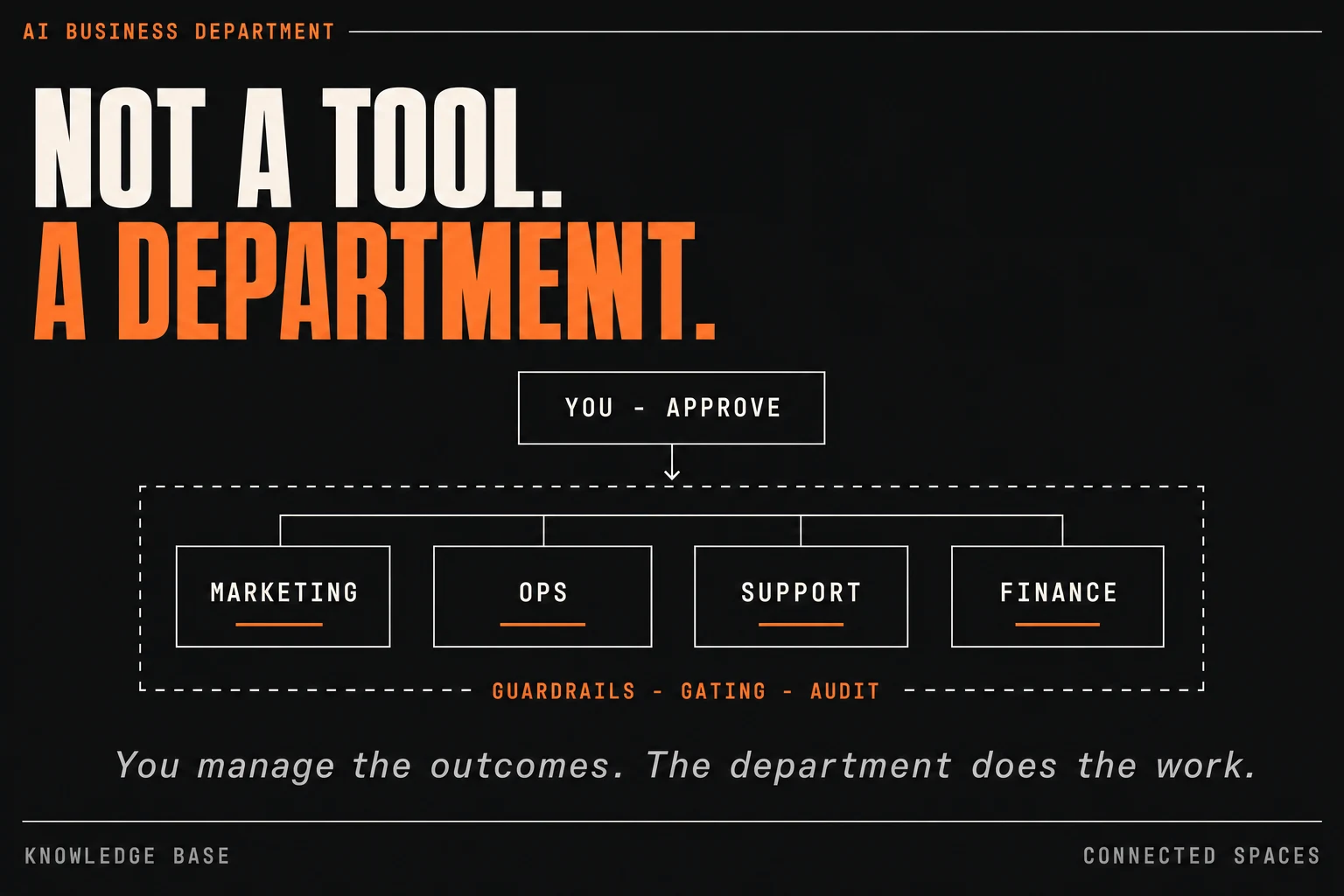
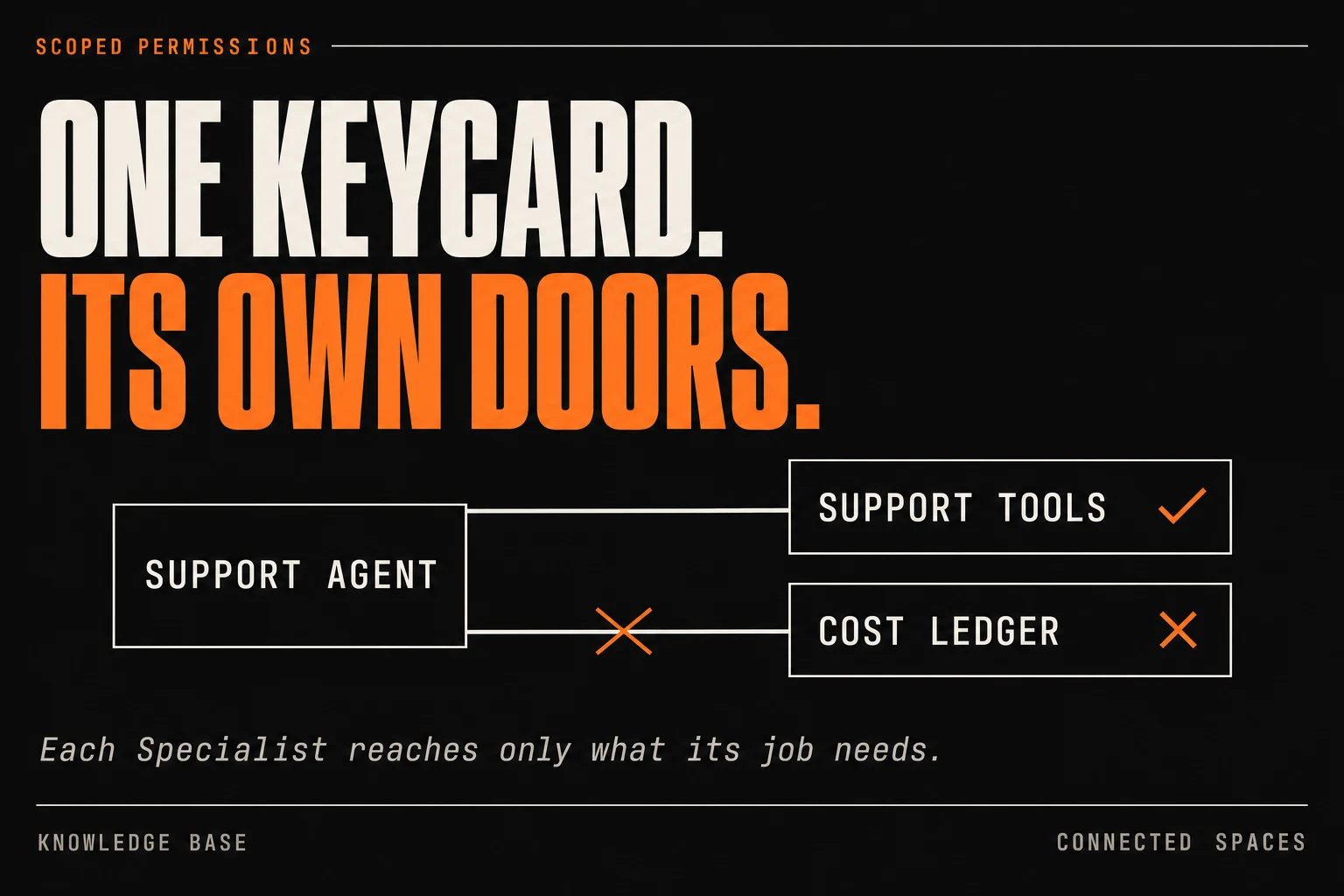
The Specialists are the agents that do the work — drafting supplier responses, monitoring campaign metrics, flagging cost anomalies, preparing reorder recommendations. Each one has a strictly defined role. Each one has a keycard: it only opens the doors its specific job needs. You wouldn't ask your line cook to run payroll. A Specialist assigned to customer support was never granted access to your cost ledger. That's not a policy setting — it's scoped permissions, built into the architecture.
The oversight layer is not a separate agent. It is the combination of guardrails, gating, and an audit trail that wraps every Specialist's work:
- Guardrails constrain what each agent can do — the tools it can call, the data it can reach, the actions it can take.
- Gating puts you in the loop on decisions that matter. When a Specialist reaches an action that is consequential — sending a supplier communication, committing budget, publishing a campaign — it stops. You see exactly what it intends to do. You approve or reject. Then it acts, or doesn't.
- Audit trail logs every action to a reviewable record. Every agent. Every action. Every time. When someone asks what happened and when, the answer is already there.
Approval gates apply to consequential actions within configured permissions and authority boundaries. Preparation and routine work are distinct from decisions that require explicit sign-off; the audit trail records execution.
What SMBs Get That They've Never Had
Most small and mid-market businesses don't have a defined governance posture for software. Tools are added, credentials are shared, and no one really knows what has access to what.
Connected Spaces brings structure most owners have never had: each agent has a defined role, scoped permissions, an explicit authority boundary, and a record of everything it does. The win is not "impenetrable security" — it's operational structure. You know what your AI agents can do. You know what requires your approval. You have the record.
We build on the guardrail and role controls in the modern multi-agent frameworks we use, plus our own guardrail layer configured to the risk tolerance you set. We don't reinvent the wheel. We configure it to your business.
We are not a partner or certified affiliate of any AI or infrastructure provider.
Persistent vs. Ephemeral — The Foundation Under the Department
The department frame describes how agents are organised and governed. The Nest Protocol also describes how they exist — and it's a different design from most AI tools.
| Capability | Always-on AI Agent | ClawdBot — Nest Protocol |
|---|---|---|
| Exists between your requests | Yes — running, reachable, holding credentials | No — created for the task, gone when done |
| Holds credentials between sessions | Yes — keys stored at rest | No — encrypted per-request, destroyed after |
| Where agent code runs | Server or browser, depending on implementation | Server-side only — enforced, not optional |
| Memory shared across agents | Often — shared state is common | Never — memory is isolated per agent |
| Identity verified each action | No — session persists from login | Yes — rebuilt from authenticated session every time |
Born. Execute. Gone. No lingering process, no credentials at rest, nothing to reach between sessions.
For the full technical architecture — including AES-256-GCM credential encryption, prompt injection defense, and the six governance pillars in detail — see Governance and Security.
Six Governance Pillars
The department is governed by six architectural commitments:
- Accountability — Every action is attributed to a named agent with a defined scope. No anonymous actions. You know who did what.
- Agent Identity — Each agent operates under a dedicated non-human identity. No shared API keys, no generic system accounts.
- Server-side controls - Agent instructions live server side. Policies and scoped permissions constrain permitted actions.
- Auditability — Every action logged to a reviewable audit trail. Timestamped, reviewable, exportable.
- Data Privacy and Permissions — Agents access only the data they are explicitly granted. What one agent knows, another cannot access.
- Human Override — A person you authorize can stop an agent. Consequential actions wait at an approval gate, and an approval request that nobody acts on expires on its own.
The Ownership Angle
Qualifying customer-specific custom IP ownership starts in subscription month 13. The underlying CNX platform and framework do not automatically transfer. Agree the custom inventory, retained components, third-party dependencies and handoff process.
Putting It Together
The AI Business Department is the outcome. The Nest Protocol is the architecture underneath it. Together they answer the question most owners ask when they first hear about AI Agents: "Who controls this?"
An AI Business Department organises AI Agents as Specialists with strictly scoped roles, guardrails on what they can do, and an approval gate so nothing consequential happens without your say-so. The org chart you already understand — each agent has a defined job, a keycard that only opens the doors its job needs, and a reporting line back to you on anything that matters.
The Nest Protocol defines how those agents are created, governed, and destroyed. It covers the two-tier model (Specialists plus the oversight layer), the ephemeral execution model (agents exist for the task and are gone after), scoped permissions, encrypted communications, and the six governance pillars. The oversight layer is not a separate AI that reviews everything — it is the combination of guardrails, gating, and a reviewable audit trail that wraps every Specialist's work. Consequential actions stop at your approval gate before they run. That is the honest mechanism.
If something goes wrong, a person you authorize can stop the agent. That is set up as part of your guardrails, with limits on what it can see and do and a person approving anything consequential. Runs are bounded by design: each one has a step and time limit, and an approval request that nobody acts on expires on its own.
The question of whether this makes your business "secure" deserves a direct answer: no, and we won't claim it does. What we claim is specific. The design reduces the attack surface. Ephemeral execution, scoped permissions, server-side-only code, encrypted credentials, dedicated agent identities, human approval gates, a reviewable audit trail, a way to stop it — each one is a named architectural decision. The result is structure most owners have never had for software. Not a guarantee, but a governance posture worth building toward owning.
Explore which plans include the AI Business Department
Related
- Governance and Security — The full technical design guide: six governance pillars, human approval gates, infrastructure foundation.
- ClawdBots: Born, Execute, Gone — The Specialist agents in your AI Department, explained.
- Ephemeral AI Agents — What They Are — Why agents that don't linger mean less standing risk and less for you to manage.
- Your AI Team — How the full team of AI Agents is organised and how you direct them.
- From Message to Execution — The full journey from your instruction to a completed action.